
KNOWLEDGE BASE · RESEARCH RESULTS
Treating rib fractures with the Chrisofix® rib splint
Following a rib fracture, pain can make both breathing and everyday movement difficult. A small clinical study tracked outcomes when standard treatment was supplemented with an external chest brace.
This article summarizes the results of an officially approved clinical study. The study was conducted with ethical and ministerial approval; its results were published in the Injury journal in 2025.
View the results ↓
THE BOTTOM LINE IN A MINUTE
Promising results for an adjunctive treatment option
In the group treated with the external stabilizer, lower average pain scores were recorded at the one-month and three-month marks, and the average hospital stay was shorter. The stabilizer was an adjunct to standard care, not a replacement for it. [1]
What was studied?
The study, published in the journal Injury in 2025, compared outcomes for 34 patients hospitalized with chest injuries and at least three rib fractures. Patients were followed for three months. [1]
with at least 3 rib fractures
Standard care
+ external stabilizer
Pain management and breathing exercises, supplemented by an external chest stabilizer.
Standard care
Care provided in the study, without an external fixator.
Summary of the study design (prepared by the author). Both groups received standard care. Source: study methodology and Table 1. [1]
How did pain levels change?
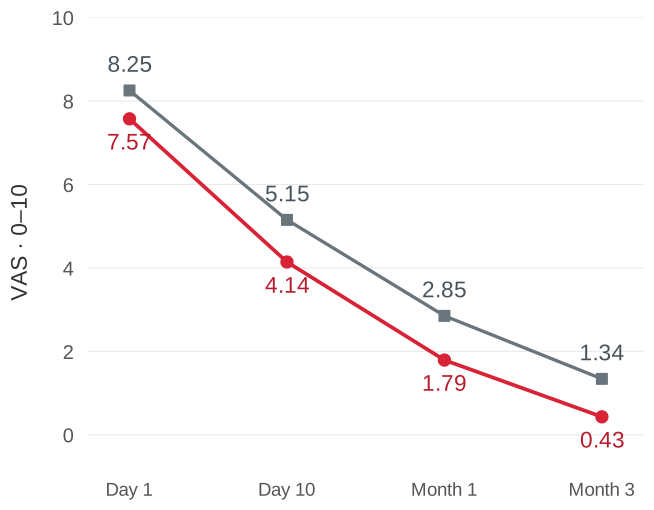
Pain was assessed on a 0–10 scale: 0 indicated no pain, and 10 indicated unbearable pain. Mean pain scores decreased in both groups. At months 1 and 3, the mean score was lower in the group treated with the fixator, and the difference was statistically significant. [1]
01 · Pain during follow-up
Two groups, four measurement time points
What does statistical significance mean?
It indicates that, based on the statistical test used, the difference between the groups was significant according to the chosen threshold. It does not in itself prove a cause-and-effect relationship, nor does it indicate the magnitude of benefit expected for every patient. In this study, the threshold was p < 0.05.
The average hospital stay was shorter
Patients receiving the brace in addition to standard treatment spent an average of 2.0 days in hospital, compared with 2.7 days in the control group. The difference between the group averages was 0.7 days. [1]
02 · HOSPITAL STAY
2.0 and 2.7 days
Averages of two groups in the same study
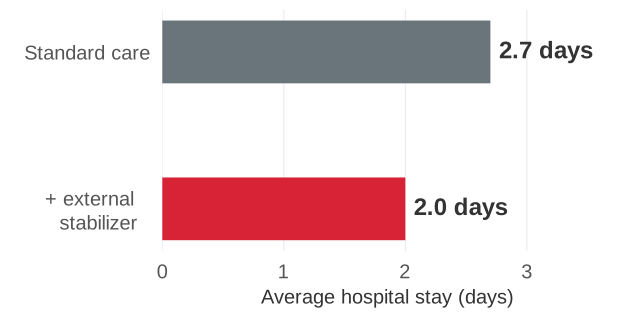
The time spent in the hospital is not the same as the healing time for a rib fracture. Nor does the result mean that any specific patient will definitely be able to go home 0.7 days earlier.
What might this mean for the patient?
Pain management and breathing exercises were key components of the treatment under study. The research investigated whether external support for the injured chest wall could provide additional benefit alongside this care.
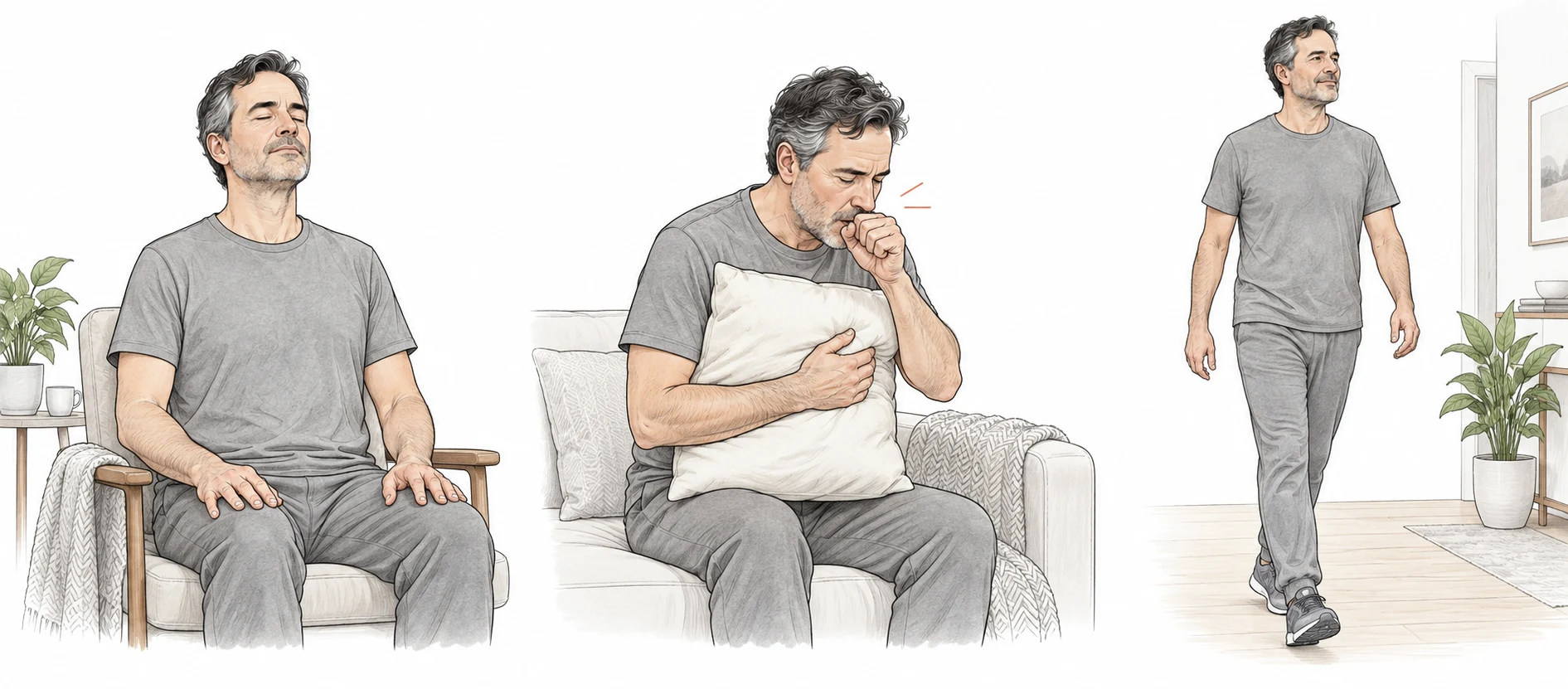
According to the authors, reduced pain may facilitate breathing exercises. However, this is not synonymous with a proven improvement in respiratory function: no such measurement is included in the reported results. The choice of treatment remains the responsibility of the attending healthcare professional.
For information on symptoms, examinations, and recovery, please read our detailed patient information leaflet on rib fractures.
Methodology and detailed data for professionals
The study was conducted in accordance with the Declaration of Helsinki principles.
Prospective, single-center study; patient enrollment between December 2020 and December 2021. Inclusion criteria: isolated chest trauma and at least three rib fractures. Exclusion criteria included, among others, bilateral rib fractures, flail chest, injuries outside the chest, and cases requiring drainage during initial care.
The mean number of rib fractures was 3.93 in the fixation group and 4.80 in the control group (p = 0.063). This baseline difference, along with the classification method, warrants cautious interpretation. The standard deviations associated with the reported means are shown in the table below; these are not confidence intervals.
| Time point | + splint n = 14 | Control n = 20 | p |
|---|---|---|---|
| Day 1 | 7.57 (1.39) | 8.25 (1.91) | 0.197 |
| Day 10 | 4.14 (1.16) | 5.15 (1.59) | 0.097 |
| Month 1 | 1.79 (0.80) | 2.85 (1.53) | 0.022 |
| Month 3 | 0.43 (0.64) | 1.34 (1.59) | 0.032 |
The authors reported receiving university research funding and declared no conflicts of interest. The study did not compare different brands of rib splints. The publication makes no claims guaranteeing individual results.
Learn more
References
Kececi Ozgur G et al. Comparative evaluation of external chest wall fixator treatment effectiveness in patients with rib fractures. Injury. 2025;56(10):112675. DOI: 10.1016/j.injury.2025.112675.
Injury · DOI: 10.1016/j.injury.2025.112675