
KNOWLEDGE BASE · RESEARCH RESULTS
Chrisofix® rib splint and early pain relief
After a rib fracture, pain can make breathing, coughing, and movement difficult. A study conducted in Turkey involving 60 patients compared pain levels during the first 48 hours when standard care was supplemented with a Chrisofix® chest orthosis.

THE ESSENTIALS IN A MINUTE
Lower pain levels during the first two days
Lower average pain scores were reported in the group treated with the rib splint during measurements taken after the baseline assessment. The results are promising, but the small retrospective study cannot definitively determine to what extent the rib splint caused the observed difference. The device was used as an adjunct to standard care.[1]
What was studied?
A study published in 2024 analyzed data from 60 adults hospitalized with traumatic multiple rib fractures. In addition to standard treatment, 30 patients received a Chrisofix® chest orthosis, while 30 patients formed a control group treated without the orthosis. Researchers retrospectively evaluated previously recorded patient data.[1]
This study evaluated the early pain-relief effectiveness of the Chrisofix® RibSplint chest orthosis as an adjunct to standard care. The RibSplint group had lower mean pain scores at 24 and 48 hours.
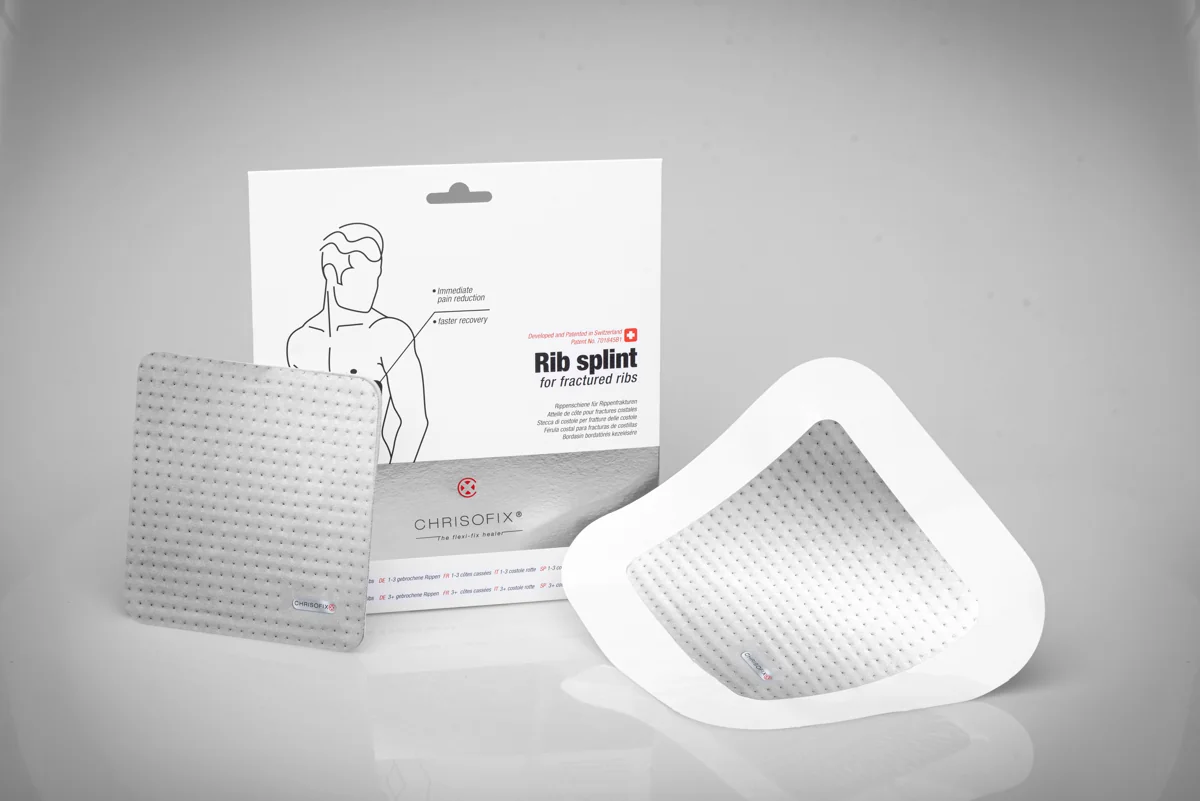
How did early pain levels progress?
Pain was assessed using a 0–10 visual analog scale (VAS): 0 representing no pain and 10 representing the worst pain imaginable. Lower values compared to baseline were measured in both groups. Group averages at 24 and 48 hours:
| Time point | + rib splint 30 patients | Control 30 patients |
|---|---|---|
| 24 hours | 3.23 | 4.50 |
| 48 hours | 2.86 | 4.66 |
Group averages, not individual patient trajectories. The p-values reported by the authors were 0.012 at 24 hours and 0.001 at 48 hours. Source: Table 2 of the publication.[1]
According to the reported statistical analysis, the differences were significant. However, this in itself does not prove a causal relationship, nor does it imply that every patient experiences the same degree of pain reduction.
How should the results be interpreted?
Early pain scores suggest that local external support of the injured chest wall may play an adjunctive role in the management of rib fractures. In the study, the rib splint did not replace analgesic treatment. The choice of treatment and the use of the device are the responsibility of the attending healthcare professional.
A lower pain score is not synonymous with faster bone healing. The research does not allow for conclusions regarding the independent effect of the rib splint or its expected benefit in all cases of rib fracture.
Methodology and detailed pain data for professionals
Patient data were derived from treatments provided between October 2018 and October 2021. The report describes the inclusion of adults treated for at least three rib fractures, but the threshold for the number of fractures is not stated consistently throughout. A Mann–Whitney U test is reported for the comparison of groups.
| Time point | + rib splint, n=30 | Control, n=30 | Reported p-value |
|---|---|---|---|
| Baseline | 6.26 (1.57) | 5.66 (1.93) | 0.031 |
| 1 hour | 4.13 (1.83) | 5.06 (1.76) | 0.026 |
| 7 hours | 3.06 (1.77) | 5.16 (1.28) | 0.004 |
| 24 hours | 3.23 (1.77) | 4.50 (1.22) | 0.012 |
| 48 hours | 2.86 (1.59) | 4.66 (1.17) | 0.001 |
The table presents published data; no re-analysis of pain outcomes based on raw patient data was performed. The publication does not report the treatment effect adjusted for baseline differences or the correction for multiple comparisons. According to the authors, the difference in hospital stay duration was not significant. The reported significance regarding complications is not clearly supported by the case numbers shown in the table.
Learn more
Clinical summary of long-term outcomes →
References
Işıklı AG, Yanık F, Karamustafaoğlu YA, Yörük Y. Evaluation of Chrisofix® Chest Orthosis Application in Patients with Traumatic Rib Fractures. Bangladesh Journal of Medical Science. 2024;23(1):83–88. DOI: 10.3329/bjms.v23i1.70689.