
Rib splint for chest injuries
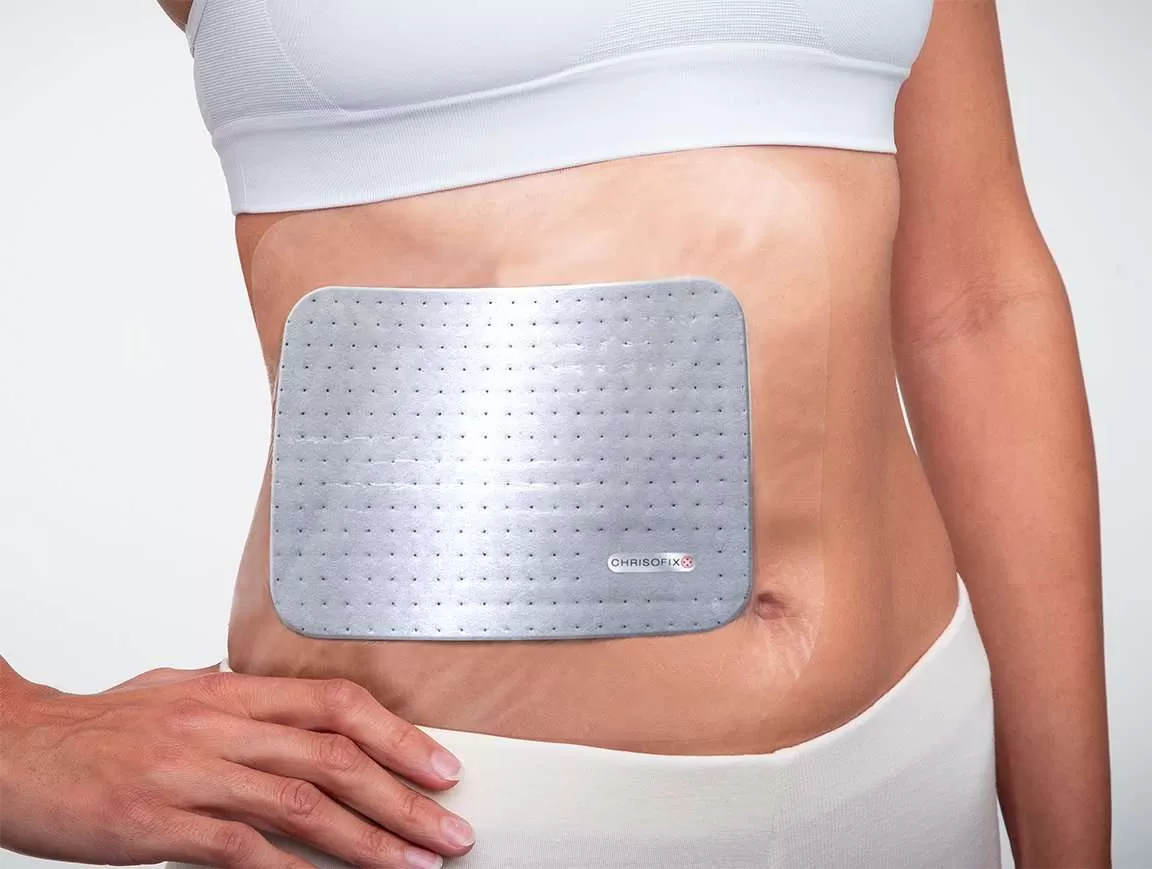
The Chrisofix rib splint provides local support across the injured chest area. It may be selected as part of care for rib fractures, chest contusions and specified postoperative applications. Assessment and application by a healthcare professional are required.
Product overview
Single-use rib splint; sizes S and L. Size S: 12 × 17 cm, item 604 226 104. Size L: 17 × 17 cm, item 608 226 104. The injury location and extent determine selection.
Why this design?
Local support
The splint bridges the injured rib area. Its position is chosen for the individual injury rather than wrapping the entire chest.
Malleable construction
The splint can be shaped to the chest. Initial shaping is performed on the uninjured side by a healthcare professional.
X-ray transparent
The product construction is transparent to X-rays. Accurate medical localisation of the fractured ribs is required before application.
Indications
A healthcare professional may select the rib splint as part of care for the following manufacturer-listed applications:
- Chest contusions and rib fracture or fractures.
- Flail chest, as part of care intended to prevent paradoxical breathing. This is a serious injury requiring medical management.
- Care following thoracic surgery, as directed by the treating professional.
How it works
The fitted splint bridges the injured area and provides local support. Correct positioning, shaping and handling of the protective layers are essential parts of professional application.
Fitting and use
Assessment: the fracture location must be established medically, including the X-ray control specified for this product, before the splint is applied.
Application: a healthcare professional prepares the skin, shapes the splint on the uninjured side and places it across the injured area. The patient is preferably seated or standing.
Final check: the outer transparent protective film is removed last. The order of removing the layers matters; this summary is not a self-application guide.
What does the clinical research show?
A small comparative study published in Injury in 2025 included 14 patients treated with an external chest wall fixator alongside standard care and 20 receiving standard care alone. The results below describe these study groups, not a guaranteed outcome for each patient.
| Outcome | Fixator plus standard care (14 patients) | Standard care (20 patients) |
|---|---|---|
| Average pain score at one month (VAS) | 1.79 | 2.85 |
| Average hospital stay (days) | 2.0 | 2.7 |
| Patients with recorded complications | 2 / 14 | 8 / 20 |
The pain and hospital-stay differences were statistically significant; the complication difference was not.
VAS is a pain-rating scale; a lower score means less reported pain. The groups were small and differed in size. The splint is one possible part of an individual treatment plan, alongside the care prescribed by the treating professional.
Read the study summary on PubMed (English)
Injury 56(10), 112675 (2025). DOI: 10.1016/j.injury.2025.112675.
Rib splint application video (English)
Watch the Chrisofix application demonstration: what the rib splint is used for and how it is fitted. The video is in English and supports the written summary; application remains a healthcare professional’s task.

The player loads only when you choose to play the video.
Sizes and item numbers
The manufacturer lists S for one to three fractured ribs and L for more than three. Injury location and extent must also be assessed; the table alone does not determine the correct treatment.
| Size | Splint dimensions | Manufacturer size guidance | Item number |
|---|---|---|---|
| S | 12 × 17 cm | 1–3 | 604 226 104 |
| L | 17 × 17 cm | > 3 | 608 226 104 |
Single use and care
This is a single-use product, described on the current product page for approximately ten days of use. Longer treatment may require a new splint. Do not reuse or apply hand-orthosis washing instructions. If the covering film has been removed, temporary water protection is needed for showering; ask the treating professional about skin and adhesion checks.
Materials
Polyethylene foam, corrugated and perforated aluminium, skin-contact adhesive, breathable film and removable paper layers. The device is not sterile.
Important limitations
Professional assessment and application are required. Use on clean, intact skin or after appropriate wound care. Do not cut the splint or use a damaged product. Skin irritation may occur; use is not recommended with known acrylic sensitivity. Discuss itching, skin reactions or adhesion problems with the treating professional.
Frequently asked questions
Can I apply it at home on my own?
No. The injury must be located accurately, and shaping and protective-layer handling require professional application.
Can the rib splint be washed or reused?
No. It is a single-use product. The washing and same-patient reuse rules of hand orthoses do not apply.
How long is it used?
The current manufacturer page describes about ten days of single use. Longer care may require a new splint; the treating professional determines the plan.
When to seek urgent help
Worsening breathlessness or chest pain, coughing up blood, or injury after a serious accident require urgent medical attention. The rib splint does not replace assessment or treatment of chest injuries.